
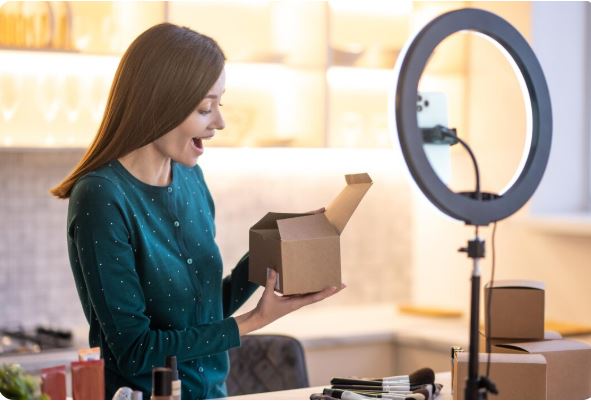
A packaging team can spend months getting a pack exactly right — the structure, the substrate, the label artwork, the sustainability story printed cleanly on the back panel — and the first time most of the world meets that work, it will be as a thumbnail on a phone. Not on a shelf, where the materials and the weight and the finish do their job. On a screen, at the size of a postage stamp, competing with a grid of rivals.
This has quietly changed what a packaging launch has to deliver. The pack still has to perform physically. It now also has to perform as a digital asset, often weeks before a single unit ships — in the retail buyer deck, the distributor catalogue, the marketplace listing, the launch campaign. A dieline shows the structure. It does not show the selling moment.
What the flat files leave out
Inside the packaging workflow, a pack lives for a long time as technical files: the dieline, the label artwork, the spec sheet, maybe a white sample or a printed proof. These are exactly what production needs, and exactly what a buyer or an ecommerce team cannot read.
A flat artwork file does not communicate how a soft-touch matte laminate will actually feel against a high-gloss accent. It does not show how the label sits on a curved bottle versus how it looked laid flat. It gives no sense of scale — whether this is the travel size or the family size — and no sense of the finished object as a customer will encounter it. For everyone downstream of the dieline, the gap between the technical file and the perceived product is where confusion, slow approvals, and last-minute content scrambles come from.
Seeing the finished pack before it exists
The fix is to give the non-technical stakeholders something they can actually evaluate, earlier than physical samples allow.
For packaging teams preparing a product launch, 3d product rendering can help turn pack structures, label designs, materials, and product references into polished visuals for ecommerce pages, retail decks, catalogs, and campaign assets. Built from the same structural and artwork data the team already has, a render can show the pack as it will be perceived: the label in position on the real form, the finish reading as matte or metallic or transparent, the cap and closure in proportion, the variant colourways side by side, the whole thing at a scale a person can judge. Material and colour approvals can happen against something that looks like the product rather than something that requires imagination to bridge. And launch visuals can be ready while the first production run is still being scheduled, rather than waiting on final photography that, by definition, cannot happen until physical product exists.
For a cosmetics line with eight shades, a beverage in three pack sizes, or a household product across a refill range, that head start on visuals is often the difference between hitting a launch window and slipping it.
One image was never going to be enough online
A shelf lets a shopper pick the pack up, turn it over, read the back, judge the size against their hand. A product detail page has to reconstruct all of that from a set of images, and one hero shot does not come close.
An ecommerce listing for a packaged product earns trust by answering the questions the shelf would have answered: a clean hero image, a readable close-up of the front label, the side and back panels where the ingredients and instructions live, a scale reference so nobody is surprised by the size on arrival, feature or claim callouts, the full set of variants shown honestly, and a lifestyle or in-use image that places the pack in a real context. Each of these answers a specific hesitation. Leave one out, and a share of shoppers fill the gap with doubt and move on to a listing that didn’t make them guess.
Some things a still image simply can’t show
There is a category of packaging questions that no photograph answers, because the answer is a motion.
Once the packaging design is approved, e-commerce product videos can show how the product looks, opens, functions, assembles, dispenses, or fits into a real usage scenario. This is where a lot of packaging innovation actually lives — and where it most often goes uncommunicated. A clever child-resistant closure, a refill system that clicks into a reusable base, a dispensing mechanism that is the entire point of the format, an airless pump, a pack that opens in a deliberately satisfying way: all of these are selling features in motion and invisible in a still. A short video showing the open, the dispense, the refill, or the assembly turns a feature the team engineered into a feature the customer can see and value.
Visuals get the whole organisation onto the same page
The value of strong pack visuals is not only customer-facing. A surprising amount of it is internal, in the gap between “the design is approved” and “the launch is live,” where a dozen teams have to agree on something most of them cannot yet hold.
A render or a short demo gives packaging, marketing, sales, and leadership a shared, concrete thing to react to in approval rounds — which surfaces objections early, when they are cheap, rather than after print. Retail buyer presentations land better when the buyer can see the finished pack and its shelf presence instead of interpreting a flat proof. Distributor catalogues and sales decks built from one approved set of visuals stay consistent across every partner. The same assets brief the ecommerce team, train the sales force, and anchor the launch campaign. One visual source, many internal users, far fewer versions of the truth circulating.
Smart and sustainable features need showing, not just stating
Two of the areas this industry is investing in hardest — connected packaging and sustainability — are also two of the hardest to communicate in a flat file, because their value is in how they work.
A QR code, an NFC tag, or an RFID-enabled label is a printed square until something demonstrates the experience it unlocks; a short sequence showing the scan and what follows makes the feature legible. Sustainability claims face the same problem in reverse — “refillable,” “recyclable,” “made from X% recycled material” are words competing with every other brand’s identical words. A visual that shows the refill actually clicking into its base, the mono-material structure separating cleanly for recycling, or the reuse the pack is designed for makes the claim concrete in a way the on-pack text alone never will. For features the brand spent real money to build in, that is the difference between a benefit communicated and a benefit assumed.
A visual checklist before a pack goes live online
Worth confirming before launch, across the packaging and ecommerce teams: Are the pack renders approved and final? Is the label legible at the sizes the listing will actually use, including mobile? Are all variants and pack sizes covered? Are the ecommerce image formats prepared to each channel’s spec? Does anything about the pack — opening, dispensing, assembly, a smart feature — warrant a short video? Are the sustainability claims shown, not just stated? Are the retail buyer and distributor visuals ready ahead of the meetings that need them? Have the marketplace-specific requirements been checked? And is the whole set consistent across sales, ecommerce, and marketing?
A gap found on this list is an afternoon’s work. The same gap found by a retail buyer, or by a shopper comparing your listing to a competitor’s, is a slower approval or a lost sale.
Packaging presentation has become part of the launch workflow rather than a step that follows it. The pack still has to protect the product, carry the brand, and earn its place on a shelf — but it increasingly has to do all of that first as a digital asset, in front of buyers and shoppers who will judge it before they ever hold it. The teams that prepare those visuals early align faster internally, present more confidently to retail, and arrive at launch with the content their channels need already in hand, instead of discovering the gaps the week the product ships.

